“Guaranteed tenant for 12 months.” “Guaranteed rent.” “We guarantee your investment.” If you’ve shopped for a property manager in Dallas–Fort Worth, you’ve seen the headlines. And they’re appealing for a reason — being a landlord comes with real risk, and the idea that someone will simply guarantee it away is a relief.
Here’s the honest truth, and we’ll say it plainly: some of these guarantees are meaningful, and some are mostly marketing. The word sounds the same either way. The difference is buried in the fine print — and that difference can cost a landlord thousands of dollars at exactly the wrong moment. This isn’t about calling anyone out. It’s about making sure you can tell the difference before you sign. Ask these six questions of any manager who advertises a guarantee, and you’ll know quickly what you’re really getting.
First, What a “Guarantee” Usually Means in this Business
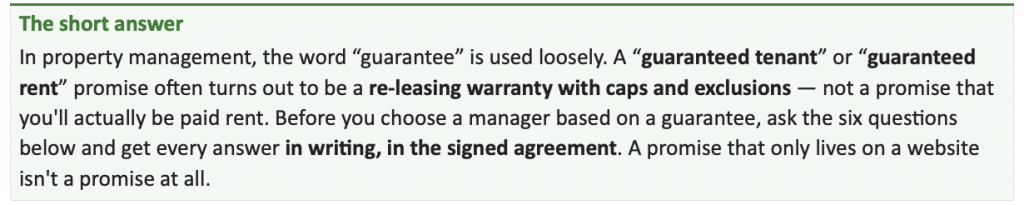
Landlords hear “guarantee” and reasonably picture guaranteed income, money in the bank whether the home is occupied or not. That specific promise is rare, and when it exists it’s usually a paid product (sometimes called rent guarantee or rent-default insurance) with its own underwriting and premiums. Most “guarantees” marketed by property managers are one of three narrower things:
- A Tenant-Placement (Re-Leasing) Warranty – If a tenant they placed leaves early, the manager re-leases the home without charging you a second placement fee. Useful, but it does not pay you the rent you lose while the home sits empty.
- A Capped Eviction Benefit – The manager covers eviction costs “up to” a set dollar amount, often a few hundred dollars, and frequently only on a pricier plan tier.
- A Satisfaction or Time-Window Promise – A pledge to place a tenant within a certain number of days, or your money back on part of a fee. Fine as far as it goes, but narrow.

None of these are scams, and a good re-leasing warranty is a genuine perk. The problem is only when the headline (“guaranteed tenant!”) is far bigger than what the fine print actually delivers. So make the fine print speak. Here’s how.
The 6 Questions to Ask About Any Tenant or Rent Guarantee
1. Does the Guarantee Pay Me Rent While the Home Sits Vacant?
This is the big one. Many “guarantees” only mean the manager will find a replacement tenant without charging another placement fee — you still eat the lost rent during the vacancy. If what you want is income protection, ask directly: “If this home is empty for six weeks, do you send me a rent check?” Get a yes or no, not a brochure.
2. Is There a Dollar Cap — And What Is It?
“Eviction protection” and similar benefits often top out at a specific number — sometimes just a few hundred dollars. That’s not wrong, but you need the figure. Ask for the exact cap and compare it to reality: a contested eviction in Texas, plus the make-ready and the lost rent, routinely runs well past a few hundred dollars. A cap you can’t name is a cap you can’t count on.
3. Does it Cover Lost Rent AND the Eviction AND the Make-Ready?
A tenant who stops paying but won’t leave can mean months of lost rent, legal filing costs, and a full turn once they’re gone. Those are three separate expenses. Ask which of the three the guarantee actually reimburses. Many cover one slice and let the headline imply all three.
4. What are the Conditions and Exclusions?
Guarantees almost always come with strings: they may require that you accepted the manager’s pricing and screening recommendations, kept the home in rentable condition, and didn’t cause the problem yourself. Those conditions can be perfectly reasonable — but you deserve the full list up front, not a surprise when you try to use the coverage. Ask: “Under what circumstances does this guarantee NOT apply?”
5. Is it in the Signed Management Agreement, or Pnly on the Website?
This single question settles most of them. Marketing copy is not a contract. If a guarantee matters to your decision, it needs to appear in the signed management agreement, with its exact terms. Ask the manager to show you the clause. A promise they’ll put in writing is real; a promise that lives only on a landing page is advertising.
6. What Happens After Month 12?
A lot of guarantees quietly end at the one-year mark. If yours renews the tenant into year two, does the protection continue? Know exactly when the coverage starts and stops, so you’re not counting on protection that expired months ago.

What an Honest Guarantee Actually Looks Like
A guarantee worth trusting has three traits. It’s specific (it names exactly what’s covered and what isn’t), it’s written into the agreement (not just the website), and it’s realistic (the dollar amounts actually relate to what the events cost). If a manager can hand you the clause and walk you through its limits without flinching, that’s a good sign. If the terms are vague — “we’ll cover the expenses,” with no numbers — treat the headline as marketing, not protection.
Our Approach at McCaw: No Gimmicks — We Just Earn It
We’ll be straight with you about how we compete, because it’s the whole point of this article. McCaw doesn’t rely on a flashy guarantee to win your business. We don’t dangle a promise that sounds enormous and shrinks in the fine print. What we do instead is unglamorous and far more valuable: we work hard, every single day, on the fundamentals that actually protect a landlord — careful tenant screening, fast and honest communication, prompt maintenance, and leases that hold up under Texas law. That work is what prevents the vacancy, the non-payment, and the eviction in the first place. No guarantee is as valuable as simply not needing one.
And here’s the part we’re proudest of. We don’t lock our clients into long-term contracts. Either party can end the agreement with just 30 days’ written notice. That means we have to earn your business every single month — there’s no paperwork trapping you if we ever stop delivering. A guarantee tells you what happens when a manager fails. A 30-day out tells you the manager is confident they won’t.

Frequently Asked Questions
What is a “Guaranteed Tenant” in Property Management?
It’s a marketing term for a promise a property manager makes about tenant placement. In practice it usually means a re-leasing warranty — if a tenant they placed moves out early, they’ll re-lease the home without charging a new placement fee. Importantly, most versions do NOT pay you rent while the home is vacant, so read the terms closely.
Does a Rent Guarantee Mean I Get Paid Even if the Home is Empty?
Rarely. True guaranteed income usually comes from a separate paid product (rent guarantee or rent-default insurance), not from a standard management “guarantee.” Most manager guarantees cover re-leasing or capped eviction costs, not vacancy. Always ask directly whether you receive rent during a vacancy.
Are Property Management Guarantees a Scam?
No — many are legitimate and useful. The issue is when the headline promise is far larger than the fine print delivers. A guarantee is only as good as its written terms: the dollar caps, the exclusions, and whether it’s actually in your signed agreement rather than just on the website.
What Should a Good Tenant Guarantee Include?
Specific, written terms: exactly what’s covered, clear dollar figures, the conditions and exclusions, when coverage begins and ends, and a clause in the signed management agreement you can point to. Vague language like “we’ll cover the expenses,” with no numbers, is a red flag.
Does McCaw Property Management Require a Long-Term Contract?
No. McCaw does not lock owners into long-term contracts. Either party can cancel with 30 days’ written notice, which means we have to earn your business every month. We compete on the quality of our work, not on gimmicks or paperwork that traps you.
How Do I Compare Property Managers Fairly Based on Their Guarantees?
Ask every manager the same six questions, vacancy pay, dollar caps, what’s covered, exclusions, whether it’s in the signed agreement, and what happens after month 12, and put the written answers side by side. The manager whose promises survive that comparison in writing is the one to trust.
Talk to a manager who earns it every month
If you’re comparing property managers in Dallas–Fort Worth, bring these six questions to every conversation — including ours. We’ll give you straight answers, show you exactly how we protect your property, and never ask you to sign away your flexibility. No long-term contract, no gimmicks, and a 30-day out if we ever stop earning your trust.
Author
Kyle McCaw is the founder and broker of McCaw Property Management and a Texas licensed real estate broker (License #0562767). He has been investing in and managing single-family rentals across the Dallas–Fort Worth metroplex since 2003, and personally owns a portfolio of single-family rental homes — so the strategy on this page comes from an owner who underwrites the same deals our clients do.
Kyle is an active member of the National Association of Residential Property Managers (NARPM) and has spoken at several national conferences across the single-family rental management and investing industries. McCaw Property Management is rated the #1 property management company in the Roanoke / DFW Metroplex by PropertyManagement.com and has been named to Texas A&M University’s Aggie 100 list of fastest-growing Aggie-owned businesses five times.